Founder-built product
Spanvero
A founder-built decision-support product comparing AI inference costs across local hardware, rented GPUs, and API providers.
Overview
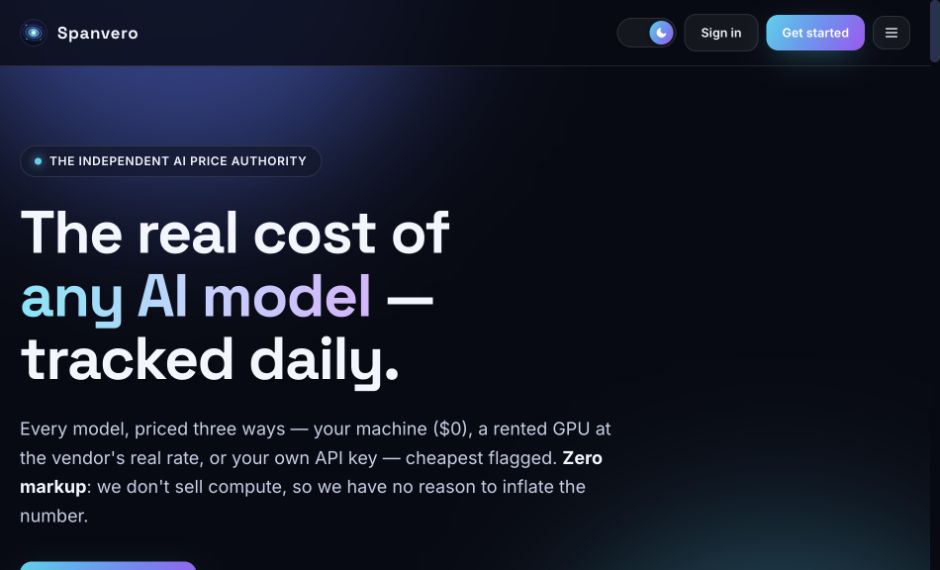
Spanvero is an independent pricing tracker for AI model costs. It compares the real cost of running a model three ways: on hardware you own, on rented GPUs, and through API providers. Spanvero does not sell compute and adds no markup, so it has no stake in which option looks cheapest.
If you run a small B2B company and you are weighing an AI feature — a proposal drafter for your agency, a candidate screener for your recruiting firm, a ticket summarizer for your MSP — the cost question is harder than it looks. Prices are quoted in incompatible units: per million tokens, per GPU-hour, per card. They change often, and every vendor page presents its own numbers in its own framing. Comparing honestly means modeling your own usage, and most owners do not have a spare week for that.
Spanvero treats this as a data problem first. It maintains a catalog of open-source models, takes daily price snapshots and keeps them as append-only history, and tracks GPU rental rates alongside API pricing. On top of that data sit the decision tools: a cost calculator, side-by-side model comparison, and price-trend views, all built on assumptions you can see and adjust.
The Outcome Lab and public price reference stay free. Spanvero offers a $19 one-time Decision Pack and measured audits, without forcing a subscription. The core promise is independence: the numbers come from tracking what providers actually list, not from reselling anyone's compute.
- Type
- Independent pricing tracker and decision-support product for AI model costs
- Role
- Research, design, build, launch — Michael Rodriguez
- Status
- Live at spanvero.com; free Outcome Lab, $19 one-time Decision Pack, and measured audits
- Built with
- Modern AI-accelerated toolchain, human-verified
How it was built
Research first
Before any interface existed, the work was understanding how this market quotes prices: per million tokens, per GPU-hour, per card, with tiers and discounts layered on top. That research produced a normalization model — a way to put three very different purchasing modes on one comparable footing.
Information architecture for volatile data
Prices change daily; model capabilities change rarely. Spanvero's structure separates the two: a stable catalog of models and hardware, with daily price snapshots stored as append-only history. That separation is why it can show trends over time instead of just today's number.
Technical translation
The hard part is not collecting prices — it is turning them into a decision a non-specialist can make. The calculator asks about your usage in plain terms and answers in cost, so you can weigh a local machine, a rented GPU, and an API bill without learning the vocabulary of each.
Transparent assumptions
Every cost comparison rests on assumptions — utilization, workload size, how long hardware stays useful. Spanvero states them instead of burying them, and lets you change them. A number you cannot interrogate is not a number you should base a purchase on.
Product logic before features
Independence is a design constraint, not a slogan. Spanvero does not sell compute and takes no markup, and that shaped what got built: tracking and comparison tools, a free Outcome Lab that is genuinely useful on its own, and a one-time Decision Pack for people who need a reusable report.
AI-assisted build, human verification
Development was AI-accelerated, which is how one person ships a data product like this at all. But pricing data and cost math are exactly where silent errors hurt, so the calculations, the snapshot pipeline, and the comparison views were tested and checked by hand.
Launch, then iterate
Spanvero shipped with a working core — catalog, snapshots, calculator, comparison — and grew from there based on what real use exposed. A bounded first version that ships beats a comprehensive plan that does not.
Why this matters to your project
What this demonstrates
Translating complexity into decisions
Spanvero's whole job is taking a volatile, jargon-heavy domain and turning it into a choice a business owner can make. That is the same work Volerin's fixed-scope services are built to do: map what is actually going on in your systems, then hand you a clear decision rather than a pile of options.
Transparent assumptions, stated scope
Spanvero shows the assumptions behind every number. Volerin engagements are structured the same way: fixed scope, fixed price, a named deliverable, and a delivery clock that starts when all required inputs are received. You should be able to see exactly what you are buying before you buy it.
One operator, end to end
Research, information architecture, design, build, testing, and launch were all done by one person. That is the operating model behind Volerin's services: small, bounded projects a single accountable operator can take from brief to shipped.
AI-accelerated, human-verified in practice
The trust line is not decoration. Spanvero used AI to move fast and human review where mistakes are costly — the data handling and the math. Client work at Volerin runs on the same rule: AI does the acceleration, a person signs off on what ships.
Spanvero is a founder-built product by Michael Rodriguez. It was built independently, not as paid client work, and appears here to show how Volerin approaches research, build, and launch. Product details reflect a review of the live site in July 2026 and may have changed since.